Clutton
Of Human BondageClutton is a reserved, difficult-to-know painter whom Philip Carey encounters in Paris. The studio community considers him able and expects him to achieve something important, but neither Clutton nor those around him can say what that achievement will be. His career moves from restless study and uncompromising opinions to a deliberate break with the Paris art world: after destroying his paintings, he leaves the city and settles alone in Gerona. Philip’s later recollections give that withdrawal a more tragic dimension, suggesting a man whose artistic ambition could not adequately express what he felt.
Identity and Introduction
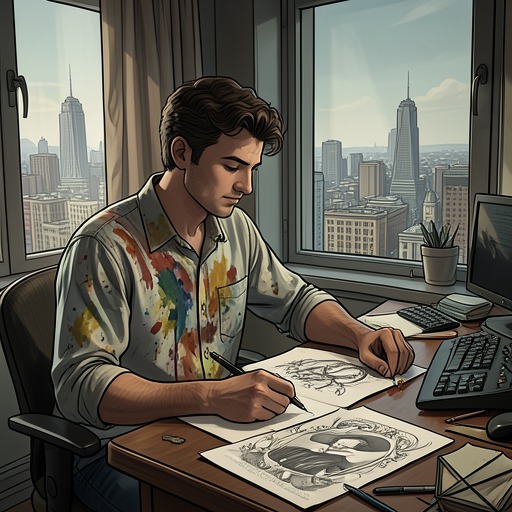
Clutton enters the studio as an observant, argumentative young man who sits beside Philip and engages Fanny Price. When she offers practical guidance, Clutton turns the discussion toward a broader challenge: whether art should be taken seriously, and whether art schools do more harm than good. He dismisses the schools as academic and objects that their teaching is incompetent. His criticism is not simply a complaint about one teacher; it anticipates his eventual effort to clear away what he has learned and begin afresh.
He is difficult for Philip to read. Even after seeing him every day for three months, Philip feels no closer to understanding him than on their first meeting. Clutton does not readily show his work, and his guardedness stands apart from the more openly sociable habits of the studio. Yet the general impression is that he is capable, and Clutton himself shares the expectation that he will do great things. The uncertainty lies in what those things are to be: his promise is widely assumed, but it has no clear form or destination.
Work and Artistic Convictions
Before joining Amitrano’s School, Clutton had worked at Julian’s, the Beaux Arts, and MacPherson’s. He stays longest at Amitrano’s because he finds that it leaves him more alone. That preference fits the distance he keeps from collective artistic life: he wants room to work without the close oversight or ready opinions of others. His reluctance to display his work makes his ability difficult to assess, even as the studio’s expectations of him remain high.
At one point, Clutton approves of a line in Philip’s drawing and tells him he is beginning to learn to draw. The response is notably specific and limited: the praise recognizes an achievement in a single line rather than offering a sweeping judgment about Philip’s promise. It also shows that Clutton can assess another painter’s work despite his skepticism about formal instruction and artistic institutions.
Clutton’s views grow more radical after he has spent time away from Paris. He says that he has thought matters through, that he is finished with the Impressionists, and that their work may soon seem thin and superficial. He wants to make a clean sweep of everything he has learned and start over. On returning, he has destroyed all the paintings he made; his studio contains only an easel, paints, and clean canvases. The cleared room gives physical form to his rejection of his previous work, but it also leaves his next artistic direction unresolved.
Philip’s Paris Circle and Later Recollection
Clutton’s aloofness shapes his relationship with Philip, who finds him less knowable than the other people around the studio. He nevertheless remains an important figure in Philip’s recollection of the Paris years. Much later, when Philip encounters a journalist at the hospital, he remembers that Clutton had spent some months in Toledo. The patient-and-staff relationship keeps Philip from openly displaying his interest, but the reference revives his curiosity about his former companion.
Philip’s retrospective judgment is more sympathetic than his earlier uncertainty. He recalls Clutton as the most interesting person he had known in Paris, while recognizing that his sardonic manner and hostile reserve had made intimacy difficult. Looking back at Clutton’s work and character, Philip sees a tragic force: Clutton seemed driven to express obscure inward impulses through painting, yet unable to find an adequate artistic form for them. Philip connects this frustration with Clutton’s sympathy for a Greek artist who had devised a new technique to express the yearnings of his soul. In this recollection, Clutton’s artistic isolation is not merely a pose; it is the visible consequence of a mismatch between intense feeling and the means available to articulate it.
Withdrawal from Paris and Ending
Clutton ultimately decides that he cannot accomplish anything while remaining in contact with art and artists. To make departure easier, he quarrels with his Paris friends and tells them what he sees as home truths; they endure these declarations as he announces that he is finished with Paris. He chooses Gerona, a small town in northern Spain that had attracted him when he saw it from the train on his way to Barcelona, and lives there alone. His departure is therefore both a repudiation of the artistic community and an attempt to remove himself from the conditions he believes obstruct his work.
The move does not supply a reported resolution to Clutton’s artistic crisis. The evidence establishes that he has abandoned his previous paintings, rejected the Paris milieu, and chosen solitary life, but it does not show what he produces in Gerona or whether the retreat enables him to fulfill his promise. His ending preserves the tension that defines him: the expectation of significant achievement remains, while the means of achieving it, and even the possibility of doing so, remain uncertain.